








Not every buyer has access to a laboratory or an ASTM-certified testing facility. But whether you're inspecting slabs at a supplier's showroom, visiting a Chinese marble factory, or evaluating a sample that arrived by courier — you can assess marble quality in minutes with five simple tests.
These tests won't replace professional inspection for large orders, but they'll help you eliminate low-quality material fast and go into negotiations with confidence.
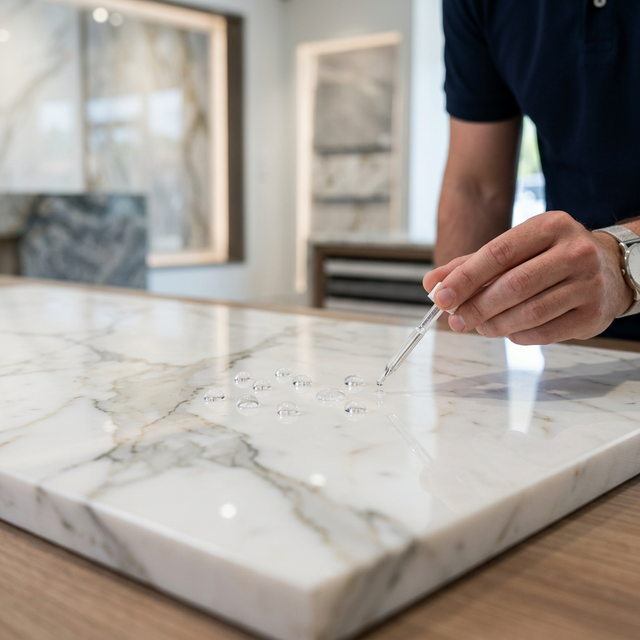
Test 1: The Water Drop Test (Porosity Check)
What it reveals: How porous the marble is. Higher porosity = more stain-prone and potentially weaker structurally.
How to do it:
- Place 3–5 drops of plain water on the marble surface
2. Start a timer
- Observe:
| Result | Time to Absorb | What It Means | Quality Indicator |
|---|---|---|---|
| Water beads and sits on the surface | > 10 minutes | Very low porosity — excellent density | ✅ High quality |
| Water slowly darkens the surface | 3–10 minutes | Moderate porosity — acceptable for most uses | ⚠️ Standard quality |
| Water absorbs almost immediately | < 3 minutes | High porosity — will stain easily and may have structural weakness | ❌ Low quality |
What the pros look for: ASTM C97 specifies water absorption should be ≤ 0.20% for quality marble. A-Grade material typically shows ≤ 0.15%.
Tip: Run this test on an unpolished edge or the rough back of the slab, not the polished face. Polished surfaces have their pores mechanically sealed, which masks true porosity.
Test 2: The Scratch Test (Hardness Check)
What it reveals: The marble's hardness and resistance to everyday wear.
How to do it:
- Find an inconspicuous spot (slab edge or back surface)
- Try to scratch the surface with your fingernail first — genuine marble should NOT scratch from a fingernail
- Then try a copper coin (penny/1-cent coin)
| Scratch Source | Mohs Hardness | Result on Genuine Marble |
|---|---|---|
| Fingernail | 2.5 | No mark — marble is harder (Mohs 3–4) |
| Copper coin | 3.0 | Very faint mark or no mark |
| Steel nail/key | 5.5–6.5 | Will scratch marble (this is normal — marble is softer than steel) |
| Glass | 5.5 | Will scratch marble (normal) |
Red flag: If your fingernail leaves a clear scratch, the material may be low-quality limestone or resin-bonded composite — not true metamorphic marble.
Related reading: What Is Artificial Marble? — learn how to distinguish natural marble from engineered alternatives.
Test 3: The Lemon Juice Test (Acid Sensitivity Check)
What it reveals: Whether the stone is genuine calcite-based marble (which reacts to acid) versus granite or quartzite (which don't react).
How to do it:
- Place a small drop of lemon juice or white vinegar on an inconspicuous area
- Wait 5 minutes
3. Wipe off and observe
| Result | What It Means |
|---|---|
| Visible etch mark (dull spot where the acid was) | ✅ Confirms it's genuine marble or limestone (calcite reacts with acid) |
| Slight fizzing when acid is applied | ✅ Definitely marble — you can sometimes see tiny CO₂ bubbles |
| No reaction at all | ⚠️ Not marble — likely granite, quartzite, or engineered stone |
Why this matters: This test confirms material authenticity. Some suppliers market granite or dolomitic limestone as "marble" to command a higher price. The acid test catches this instantly.
Caution: This test creates a permanent etch mark. Only do it on a sample piece, a slab edge, or a small, hidden area — never on the polished face of a slab you plan to install.
Test 4: The Tap Test (Structural Integrity Check)
What it reveals: Whether the slab has hidden internal cracks, voids, or delamination that aren't visible from the surface.
How to do it:
- Lay the slab flat on a stable surface (or lean it against an A-frame as typically displayed in slab yards)
- Gently knock the surface with your knuckle in 10–15 different spots — especially near edges and corners
- Listen carefully:
| Sound | What It Means |
|---|---|
| Clear, ringing tone (like tapping porcelain) | ✅ Dense, solid, no internal defects |
| Consistent tone across the slab | ✅ Uniform internal structure |
| Dull, hollow thud in some areas | ❌ Internal void, crack, or delamination — stone may break during transport or installation |
| Different tones across the slab | ⚠️ Investigate further — may indicate a filled fissure zone or thickness variation |
Pro technique: Factory QC teams at FutureStone tap-test every slab before packing. Ask your supplier if they perform this as part of their standard quality control process.
Test 5: The 1-Meter Visual Inspection (Surface Quality Check)
What it reveals: Surface defects, polish quality, and overall slab cosmetics.
How to do it:
- Stand exactly 1 meter (3 feet) from the slab face
- View it under natural light or uniform artificial light (avoid direct sunlight which can hide defects)
- Systematically scan from top-left to bottom-right, checking for:
| Defect Type | What to Look For | Acceptable for A-Grade? |
|---|---|---|
| Visible cracks | Dark lines that run through the surface | ❌ No |
| Filled fissures | Color-matched resin fills that are visible at 1 meter | ❌ No (acceptable at close inspection only) |
| Iron spots | Orange/brown dots (will rust and worsen over time) | ❌ No |
| Pitting | Small holes in the polished surface | ❌ No (acceptable for honed/leathered finishes) |
| Uneven polish | Dull patches or streaks in gloss level | ❌ No |
| Edge chips | Small breaks on slab edges | ⚠️ Minor chips from handling are normal; deep chips are not |
The 1-meter rule is an industry standard. When you specify quality in a purchase order, state: "No surface defects visible to the naked eye at 1 meter distance under uniform lighting."
Quick Reference: All 5 Tests on One Card
| Test | Equipment Needed | Time | What It Checks |
|---|---|---|---|